
Non-Destructive Testing (NDT)
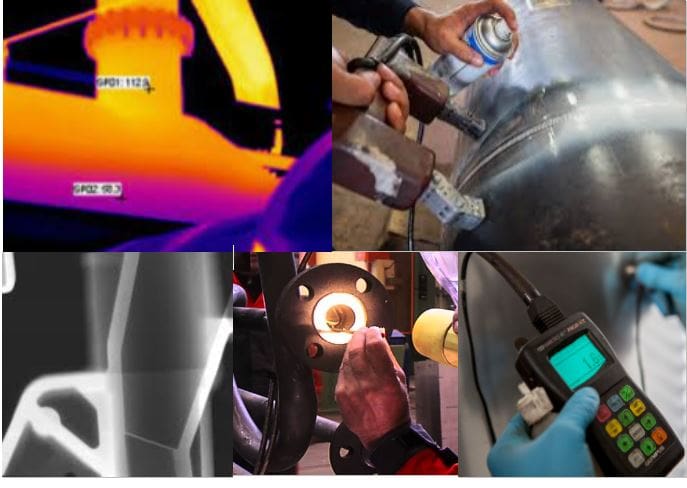
Non-destructive testing (NDT) refers to a set of examinations, tests, and inspections aimed at detecting and identifying defects in a structure or material, carried out using methods that do not alter the material and do not require the destruction or removal of samples from the structure being examined.
The purpose of NDT is to obtain the information necessary to assess the acceptability of a manufactured component.
Our company has qualified Level II personnel on staff, in accordance with the requirements of UNI EN ISO 9712 (formerly UNI EN 473), capable of performing these inspections using the following methods:
VT – Visual Testing: the primary and basic method, which must be used before any other method.
MT – Magnetic Particle Testing: verification of magnetic field flow disturbances near the surface of the part under examination.
PT – Penetrant Testing: enhances the visibility of surface defects through chromatic contrast between a liquid substance that penetrates defects by capillary action (the penetrant) and a background medium (the developer).
UT – Ultrasonic Testing: a technique that uses high-frequency acoustic waves (in the MHz range for metallic materials, and in the kHz range for more heterogeneous materials such as stone and cement-based conglomerates).
TT – Thermography: analysis of the thermal response in the presence of material discontinuities.
Following NDT, should any defects be identified, as an engineering center we are able to carry out a failure analysis and develop a structural integrity restoration project. This includes issuing a report indicating the most suitable welding procedure, prepared by a Welding Coordinator in accordance with ISO 14731.